

Why the Insurance Company's Name Isn't Enough

Updated: Sep 29
When people start shopping for health insurance, one of the first things they often look at is the insurance company. They may think, ‘I know that company,’ ‘They have a good reputation,’ or ‘My friend has them.’ Those things may be worth considering, but the insurance company's name doesn't tell you anything about the coverage you're actually buying.
Two health plans from the same company can have very different networks, deductibles, copays, out-of-pocket maximums and rules for getting care. The name on the card is only the starting point.

The Same Insurance Company Can Offer Very Different Plans
Just like how a car manufacturer's name doesn't tell you whether you're buying a basic sedan or a fully loaded SUV, you need to look beyond the carrier name with health insurance to know what you're buying. An insurance company may offer multiple types of plans, including PPOs, HMOs, EPOs and other plan designs. Each can have different rules and costs.
For example, two plans from the same insurer could have:
Different monthly premiums
Different deductibles
Different copays
Different coinsurance
Different out-of-pocket maximums
Different provider networks
So saying, ‘I have ABC Insurance’ doesn't tell you very much about what your coverage actually does. The plan matters more than the name on the front of the card.
Your Network Can Be More Important Than the Logo
One of the first things to check is the provider network. If you already have doctors, specialists or hospitals you want to continue using, don't assume they're covered just because the insurance company has a relationship with them.
Even within the same insurance company, different plans can use different networks.
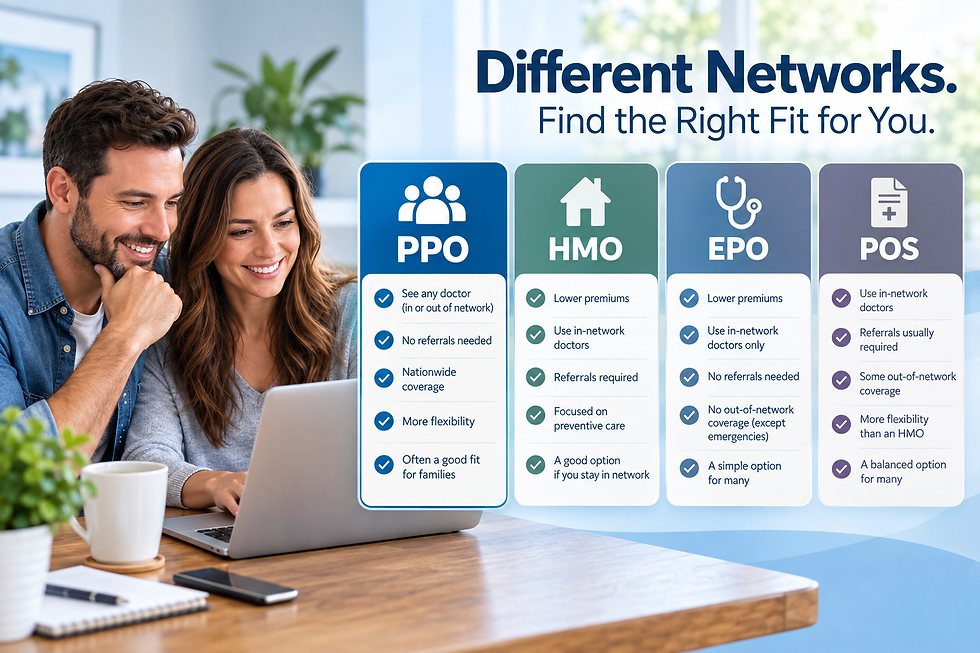
This is especially important when comparing PPOs with other types of plans. A PPO generally gives you more flexibility when choosing providers and may provide some coverage for eligible out-of-network care, depending on the specific plan. An HMO or EPO may have more restrictive network rules.
That doesn't automatically make one better than another. It means you need to understand how the specific plan works before deciding whether it's a good fit. Don't assume that a familiar name means the plan is right for you.
Look at the Numbers, Not Just the Company
Once you've confirmed that the plan's network works for you, look at how the plan handles your costs. At a minimum, pay attention to:
Premium: What you pay each month to have the coverage.
Deductible: What you may have to pay for covered services before the plan begins sharing covered costs.
Copays: Fixed amounts you may pay for certain covered services.
Coinsurance: Your percentage of the cost for certain covered services.
Out-of-pocket maximum: The plan's limit on your cost-sharing for covered services, subject to the plan's rules.
A plan with a lower monthly premium isn't necessarily the least expensive option if you expect to use a lot of healthcare. On the other hand, paying more every month doesn't automatically mean you're getting better coverage. You have to look at the entire plan design.
The Bottom Line
When comparing health insurance, don't shop for a company name. Shop for a plan.
A familiar insurance company can be a good place to start, but the details of the specific plan determine how your coverage actually works. That's why comparing the network, premium, deductible, copays, coinsurance, out-of-pocket maximum and overall plan design is so important.
If you're comparing several health insurance options and aren't sure how the plans stack up against each other, that's something we can help with. The goal isn't simply to find a familiar name, it's to understand what you're actually getting for your money.

Comments