

Health Insurance Doesn't Have to Be Complicated

Updated: Oct 12
Shopping for health insurance can sometimes feel like trying to read a foreign language. Deductibles - Copays - Premiums - Coinsurance - Networks... With all the complex terminology, it's easy to feel lost.
The good news? You don't have to become an insurance expert to make a good decision. You just need to understand the handful of things that actually matter when comparing coverage. This guide will break down the essentials of health insurance, helping you make informed decisions that cater to you and your family's unique needs.

Start With the Big Picture
When looking at a health insurance plan, don't focus only on the monthly premium. A plan that costs less every month isn't necessarily the least expensive option when you actually need medical care.
Instead, look at the details of the plan, including:
Deductible: What you pay before the insurance begins to cover costs. Plans with lower premiums often have higher deductibles. Lower deductibles typically result in higher premiums.
Copays: A fixed amount you pay for specific services, such as seeing a doctor or an urgent care visit.
Coinsurance: The percentage of covered costs you are responsible for paying after meeting your deductible. Often expressed as two numbers such as 80/20 (You'd pay 20%)
Out-of-pocket maximum: The maximum amount you will pay for covered services during the insurance term (typically a year). Once you reach this limit, your insurance covers 100% of your medical expenses for the rest of the term.
Network: The group of providers that have signed a contract with the insurance company to provide medical services at a discounted rate, keeping your out of pocket costs lower.
These pieces work together. Looking at only one of them can give you an incomplete picture.
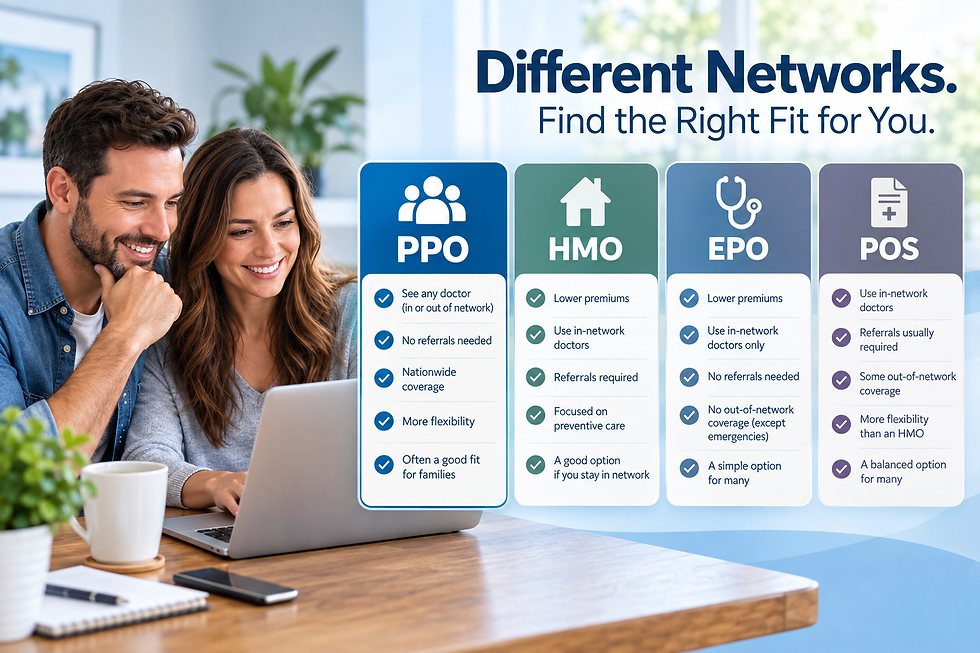
Your Network Matters More Than You Might Think
One of the biggest questions to ask isn't just "How much does this plan cost?" It's "Can I actually use it where I live and where I receive care?"
Health insurance plans use provider networks. Going outside this network often results is significantly higher prices. Some serviced may not be covered outside the network at all.
That's where understanding something like a PPO (Preferred Provider Organization) can be useful. PPO plans generally provide access to a network of doctors and facilities and may offer some level of out-of-network coverage, depending on the specific plan.
For someone who travels frequently, has doctors in multiple locations, or simply wants broader access to providers, network size and geographic access can be important factors to compare. But don't assume every PPO works the same way. The actual network and benefits depend on the specific plan.
Here's a Simple Example
Imagine you're comparing two plans. Plan A has a lower monthly premium but a higher deductible and higher potential out-of-pocket costs. Plan B costs more each month but has a lower deductible and out-of-pocket exposure.
Which one is better? There isn't a universal answer.
If you rarely use medical care, the lower premium might be appealing. If you expect a surgery or expensive procedure, the lower deductible and out-of-pocket max become much more important.
The right comparison isn't simply "Which plan is cheapest?" It's "Which plan makes the most sense for my situation and budget?"
You Don't Have to Figure It Out Alone
Health insurance is complicated partly because there are so many moving pieces, and those details can vary significantly from one plan to another.
That's where working with a knowledgeable health insurance advisor can help. A good advisor should be able to help you compare your options, explain the differences between plans, and point out things worth paying attention to without simply pushing you toward the plan with the lowest premium.
Whether your options include ACA Marketplace plans, employer-sponsored insurance, or private coverage, the goal should be the same: Understand what you're buying before you enroll.
The Bottom Line
Health insurance doesn't have to be complicated. You don't need to memorize every insurance term. Start by understanding the basics: what you'll pay each month, how you'll pay when you use the plan, where you can receive care, and what your maximum financial exposure could be.
Once you understand those pieces, comparing health insurance becomes a lot less intimidating.
And if you're still unsure how the options stack up, that's exactly where a good health insurance advisor can be useful. Sometimes having someone walk through the details with you is all it takes to turn a confusing decision into a manageable one.


Comments